Voice of a Movement
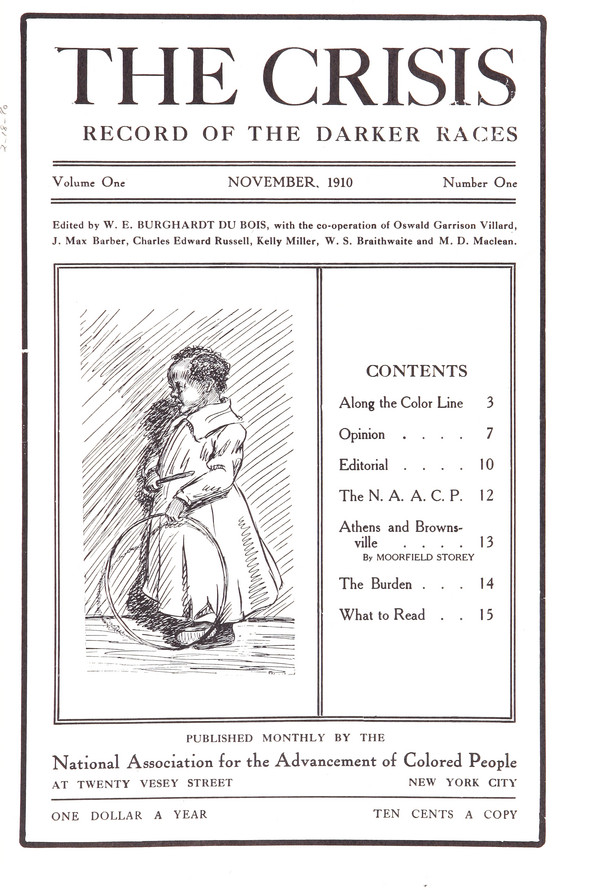 “Some good friends of the cause we represent fear agitation. They say: ‘Do not agitate—do not make a noise; work.’” So W.E.B. Du Bois wrote in November 1910, in the first issue of The Crisis. His answer was blunt: “A toothache is agitation. Is a toothache a good thing? No. Is it therefore useless? No. It is supremely useful, for it tells the body of decay, dyspepsia and death.” For twenty-four years, Du Bois made The Crisis the toothache of American democracy. He documented lynching by name and number. He tracked disfranchisement state by state. He connected Jim Crow to empire, connected empire to labor, connected labor back to the color line. And he did it in prose that could move from forensic precision to prophetic fury to Socratic satire within a single issue.
The over 700 editorials collected on this site are the record of that effort. Read individually, each is a response to a moment. Read together, they trace an intellectual arc: from Du Bois’s early faith that truth-telling would change minds, through the war’s betrayal and the Renaissance’s promise, to the bitter paradox that ended his editorship. “The thinking colored people of the United States,” he wrote in January 1934, “must stop being stampeded by the word segregation.” The man who had spent two decades fighting segregation was now arguing that the segregated had to build within the system they opposed. Six months later, he resigned.
That arc, and the hundreds of editorials that compose it, is what this collection makes visible.
Before The Crisis (1900—1910)
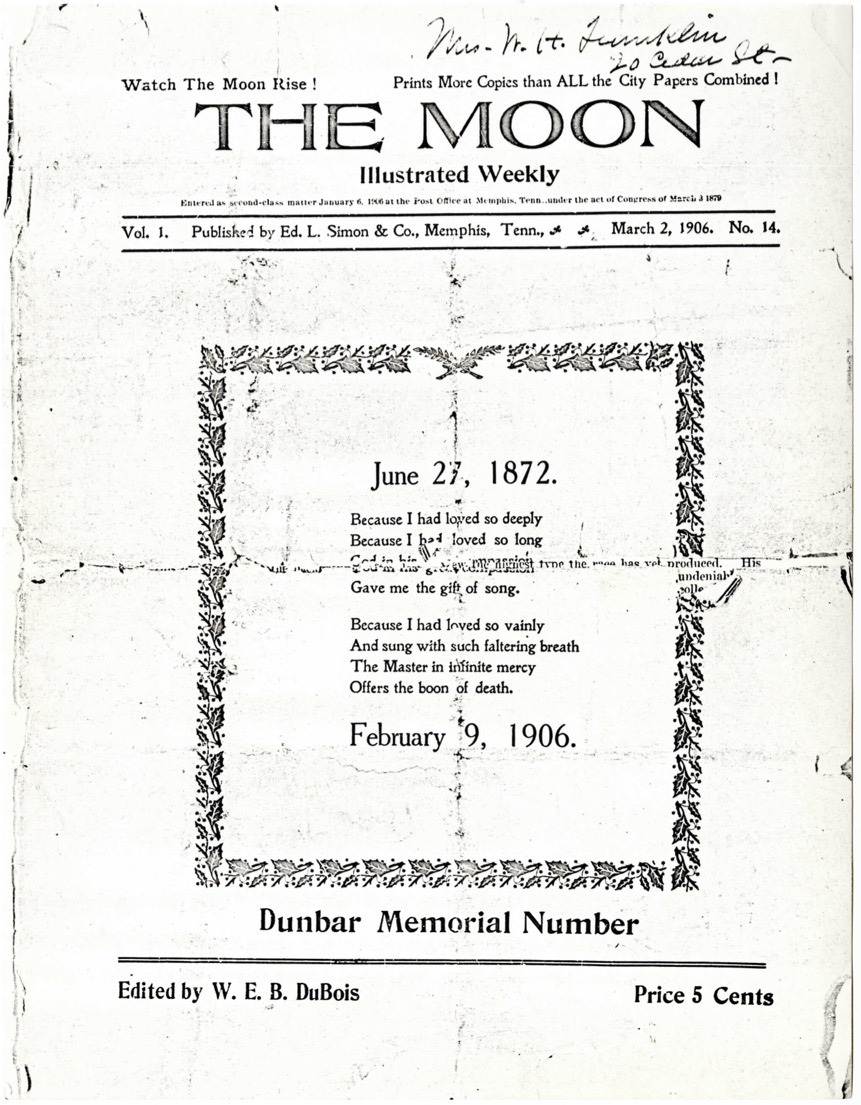
Du Bois had tried twice before. The Moon Illustrated Weekly (1905-1906), launched in Memphis with Edward L. Simon and Harry Pace, never exceeded 500 subscribers. Horizon: A Journal of the Color Line (1907-1910), published in Washington, D.C. with Freeman Murray and Lafayette M. Hershaw, lasted longer and cut deeper. Du Bois’s “Over-Look” column challenged Booker T. Washington’s accommodationism, criticized President Theodore Roosevelt, and connected domestic racism to global exploitation.
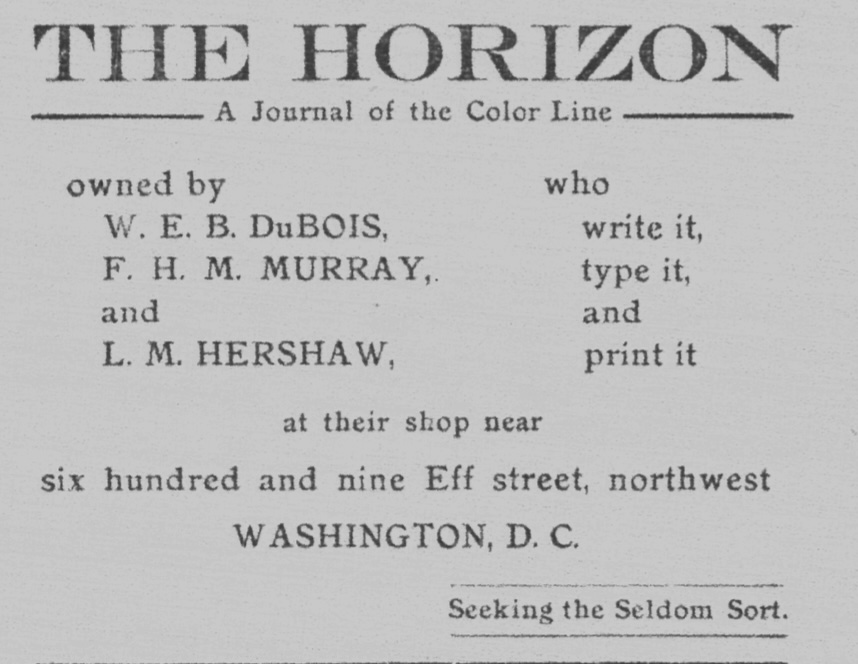
But Horizon bled money. Du Bois rejected subsidies as “degrading and dangerous.” The editors worked without salaries and covered the deficit from their own pockets. Both ventures taught Du Bois what independent Black journalism cost, and what it could do.
Establishing The Crisis (1910-1915)
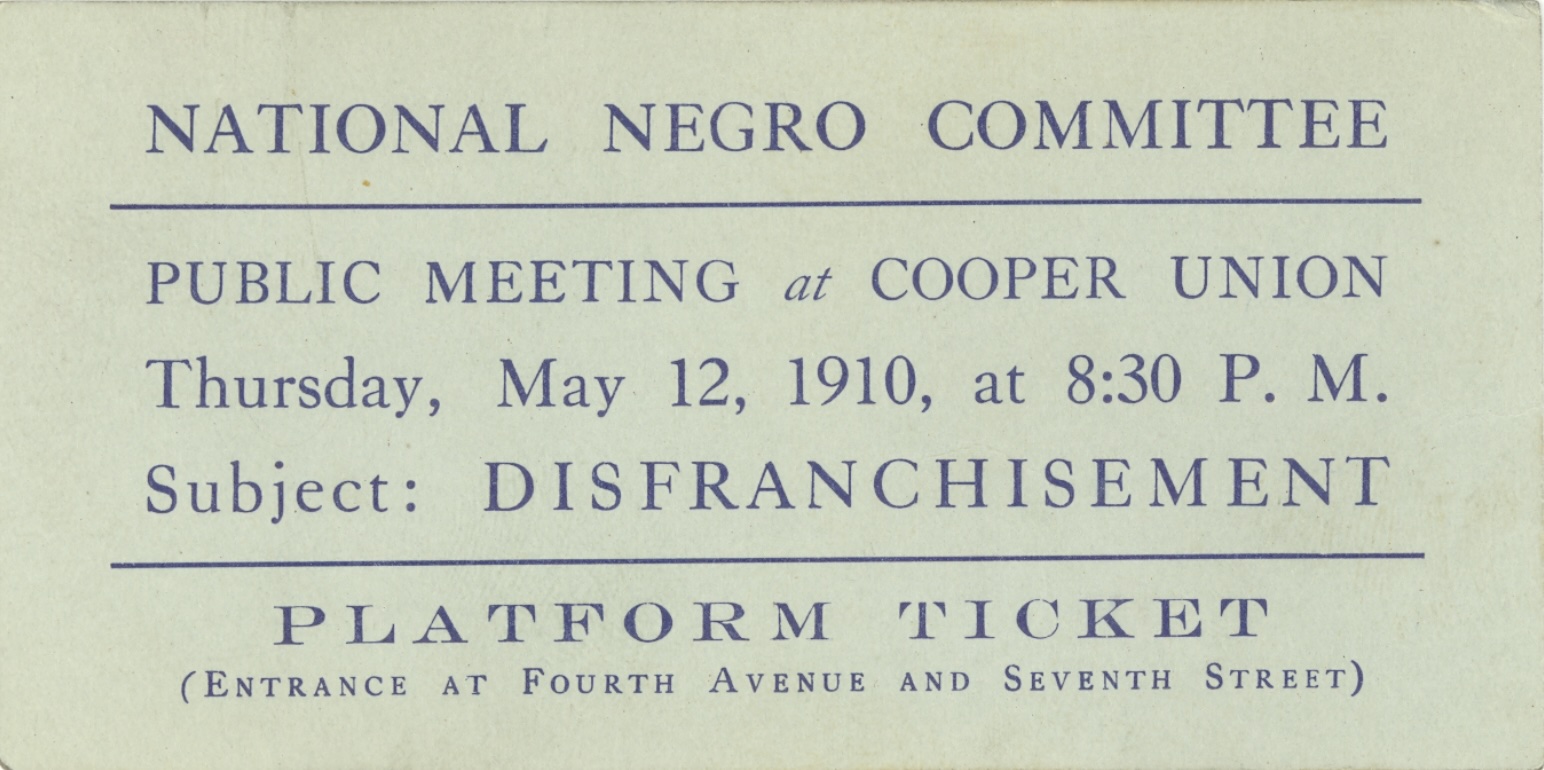 The Crisis grew out of the NAACP, and the NAACP grew out of a race riot. In August 1908, white mobs attacked Black residents of Springfield, Illinois, Abraham Lincoln’s hometown. The resulting National Negro Conference, held in New York City in May 1909, brought together Ida B. Wells-Barnett, William Monroe Trotter, Du Bois, and a coalition of white reformers. They established the NAACP, an interracial organization committed to challenging racial discrimination through legal and political action.
The organizers recruited Du Bois as the executive committee’s only African American member and director of Publications and Research. Not every prominent activist found a place. Ida B. Wells had gained international recognition for her anti-lynching campaigns and her work as editor of the Memphis Free Speech. The organizers did not include her among the NAACP’s founders. The reasons remain disputed. Either way, the omission showed how organizational politics could sideline even the movement’s most experienced voices.
Du Bois laid out his vision in the first issue: The Crisis would set forth “those facts and arguments which show the danger of race prejudice.” Its editorial page would “stand for the rights of men, irrespective of color or race, for the highest ideals of American democracy.”
The first issue appeared on November 1, 1910, with a print run of 1,000 copies and a subscription price of one dollar a year. Circulation reached 3,000 in January 1911, 6,000 in March. By April 1912, it had reached 22,500.
Some board members saw The Crisis as an organizational newsletter. Du Bois saw it as a tool for mobilizing Black America. The distinction mattered. He addressed subjects the board considered taboo: interracial marriage, the failures of Black institutions, the complicity of white liberals. The magazine’s success gave him leverage that organizational charts could not override. When NAACP board chairman Oswald Garrison Villard tried to bring The Crisis under his authority, the conflict intensified until Villard resigned in 1913.
War and Its Aftermath (1916-1923)
When the United States entered World War I, Du Bois used The Crisis to document the experiences of Black soldiers: military segregation, mistreatment in training camps, the patriotic bargain the government asked Black Americans to accept. In July 1918, his editorial “Close Ranks” urged Black Americans to “forget our special grievances and close our ranks shoulder to shoulder with our own white fellow citizens.” The position drew sharp criticism. It seemed to contradict everything Du Bois had argued before.
The May 1919 issue, which documented the mistreatment of Black troops in France, sold a record 106,000 copies. Its centerpiece was “Returning Soldiers”:
For bleeding France and what she means and has meant and will mean to us and humanity and against the threat of German race arrogance, we fought gladly and to the last drop of blood; for America and her highest ideals, we fought in far-off hope; for the dominant southern oligarchy entrenched in Washington, we fought in bitter resignation.
The editorial closed with lines that defined the postwar mood: “We return. We return from fighting. We return fighting. Make way for Democracy! We saved it in France, and by the Great Jehovah, we will save it in the United States of America, or know the reason why.”
The compact broke. During the Red Summer of 1919, race riots and lynchings swept across the country. Du Bois documented the violence and demanded federal anti-lynching legislation. He covered the Great Migration, traveling through the South to report on why people were leaving. As a Mississippi preacher told The Crisis, “The leaders of the race are powerless to prevent his going. They had nothing to do with it. … The movement started without any head from the masses, and such movements are always significant.”
Du Bois expanded The Crisis’s international reach. In February 1919, he organized the Pan-African Congress in Paris, connecting the domestic struggle against racism to global anti-colonial movements. He also took on Marcus Garvey and the Universal Negro Improvement Association, moving from cautious observation to financial forensics to outright denunciation.
By 1919, monthly circulation exceeded 100,000, surpassing The New Republic and The Nation. But the early 1920s brought a sharp decline. Circulation fell to 53,000 by April 1921, straining the magazine’s finances and deepening tensions with the NAACP board.
The Harlem Renaissance and Beyond (1924-1928)
The Crisis became a launching pad for Black writers. Jessie Redmon Fauset, the magazine’s literary editor from 1919 to 1926, identified and promoted new talent: Langston Hughes, Countee Cullen, Jean Toomer. Du Bois welcomed the movement early. Hughes gained early recognition when The Crisis published “The Negro Speaks of Rivers” in 1921. The magazine’s Krigwa literary contests gave emerging voices a path to publication. Visual artists found a platform too. Aaron Douglas’s style became synonymous with the Harlem Renaissance, and the sculptor Augusta Savage gained early recognition in its pages.
Du Bois stated his own position in “Criteria of Negro Art” (1926): “Thus all Art is propaganda and ever must be, despite the wailing of the purists. I stand in utter shamelessness and say that whatever art I have for writing has been used always for propaganda for gaining the right of black folk to love and enjoy. I do not care a damn for any art that is not used for propaganda.”
The stance put him at odds with younger artists who wanted to explore the full range of Black experience. But Du Bois was not hostile to the new voices. “Even as we ask ‘Where are the young Negro artists to mold and weld this mighty material about us?’” he wrote, “even as we ask, they come.”
Economic Crisis and Ideological Shifts (1929-1934)
The Great Depression hit The Crisis hard. Circulation fell to approximately 15,000 by 1932. Du Bois used part of his own salary to keep the magazine afloat.
Du Bois had already declared himself a socialist: “The editor of The Crisis considers himself a Socialist,” he wrote in 1921, “but he does not believe that German State Socialism or the dictatorship of the proletariat are perfect panaceas.” A two-month trip to the Soviet Union in 1926 deepened his engagement with Marxist thought. “If what I have seen with my eyes and heard with my ears in Russia is Bolshevism,” he declared, “I am a Bolshevik.” He came to view class struggle as comparable in magnitude to racial oppression, while insisting that American race relations complicated any simple application of Marxist analysis.
As the Depression deepened, Du Bois’s thinking shifted. Individual Black enterprise was futile: chain stores destroyed independent shopkeepers, unions excluded Black workers, manufacturing was closed. His answer was consumers’ cooperatives modeled on English, Scandinavian, and Russian examples.
In January 1934, he published “Segregation,” a direct challenge to the NAACP’s core position: “The thinking colored people of the United States must stop being stampeded by the word segregation.” He argued that the real enemy was not segregation itself but discrimination. He called for Black Americans to “accomplish economic emancipation through voluntary determined cooperative effort.”
In May 1934, the NAACP board voted to prohibit salaried officers from criticizing the association’s policies in The Crisis. Du Bois resigned on June 26. “So long as I sit by quietly consenting, I share responsibility,” he wrote. “If I criticize within, my words fall on deaf ears. If I criticize openly, I seem to be washing dirty linen in public. There is but one recourse, complete and final withdrawal.”
The NAACP board accepted the resignation with a tribute: “He created, what never existed before, a Negro intelligentsia, and many who have never read a word of his writings are his spiritual disciples and descendants.”
As Du Bois wrote in 1925, The Crisis had been “an enormous task for a magazine of 52 pages, selling for 15 cents and paying all of its own expenses out of that 15 cents and not out of the bribes of Big Business.” That he sustained it for twenty-four years is itself a measure of what independent Black journalism could accomplish.
What the Editorials Reveal
Read across twenty-four years, the 709 editorials collected here organize themselves around a set of interlocking problems. Du Bois returned to the same questions month after month, but his answers evolved. The collection makes that evolution visible.
The machinery of separation. Du Bois wrote about segregation in 144 separate editorials. Jim Crow cars, federal civil service segregation under Woodrow Wilson, residential restrictions, the social equality debates that white newspapers used to deflect every other argument. He attacked the system as undemocratic, unscientific, and spiritually degrading.
The machinery of terror. Lynching is the single largest subject in the collection, appearing in 134 editorials. Du Bois treated it not as aberration but as system: state-sanctioned, economically motivated, legally protected. He moved from statistical documentation to investigative reporting (the East St. Louis massacre, the Phillips County killings) to structural analysis of how mobs worked. By the late years, his conclusion was stark: “the police IS the mob. The courts ARE the lynchers.”
The machinery of law. Legal injustice runs through the corpus: the Scottsboro case, the Sweet trial, the Dyer Anti-Lynching Bill’s repeated failure. Du Bois documented how courts ratified what mobs enforced. When Black communities fought back, as at Houston and during Red Summer, the law punished the defenders.
The paradox. In his final editorial year, Du Bois held the contradiction without resolving it. Compulsory segregation was evil. Yet under compulsory segregation, the segregated had to build excellence. The arc from his first attack on segregation in 1910 through “On Being Crazy” (1923) to “Separation and Self-Respect” (1934) is the intellectual drama of the entire editorship.
War and the broken compact. The war editorials form their own narrative. Du Bois constructed a patriotic bargain, tested it, and watched it fail. Black soldiers served; America refused to honor the debt. “Returning Soldiers” is the moment the compact breaks.
The fight for the ballot. Du Bois wrote about voting and elections in 131 editorials, hammering the same arguments: the Fourteenth Amendment required reduced representation for disfranchising states; Black voters had to practice strategic bloc voting; neither party delivered.
The structures of exclusion. Labor, economics, and education account for nearly 200 editorials combined. White unions excluded Black workers. White philanthropy controlled Black schools. Du Bois’s economic thinking evolved from individual enterprise to cooperative self-organization.
The global color line. Du Bois framed American racism as part of a global system. Africa, Haiti, India, Ireland were one story. The Pan-African Congress documents were programmatic; the Africa travel writings were lyrical; the geopolitical analyses connected Jim Crow to European imperialism.
The soul. Religion, Christianity, and moral argument run through 45 editorials. “Jesus Christ in Georgia” imagined Christ encountering convict labor and mob violence. “The Christmas Prayers of God” described God witnessing a lynching and falling silent. “Pontius Pilate” cast the Roman governor as complicit in racial injustice. Du Bois framed racial justice as the test of Christian sincerity, and found Christianity failing.
Women’s rights. Du Bois linked woman suffrage to racial justice early and consistently, in 41 editorials across the full run. When writing about Black women voters at the 1920 election, pragmatism warmed into something close to tenderness.
Art and self-representation. From “In Black” (anticipating “Black is Beautiful” by fifty years) through the Harlem Renaissance criticism to “Criteria of Negro Art” and the Krigwa theatre manifesto (“About us, By us, For us, Near us”). Du Bois was cultural critic, literary reviewer, and builder of Black institutions.
The artist. Alongside the polemicist and sociologist, a different Du Bois appears in the collection: a fiction writer, poet, and satirist. “The Princess of the Hither Isles” is allegorical fable. “On Being Crazy” is Socratic dialogue anticipating absurdist literature. “Chamounix” is a prose poem about Mont Blanc with no politics at all. “The Flight into Egypt” reimagines the Holy Family as Black refugees. “The Song of the Smoke” makes blackness an emblem of industrial modernity. These pieces appear when argumentative patience is exhausted and Du Bois turns to parable.
How the Voice Changes
The editorials also reveal how Du Bois’s voice evolved, in argument and in rhetoric alike.
The founding years (1910-1914) are dominated by the public intellectual asserting facts against comfortable myths. The persona is confident, the project new. Du Bois genuinely believes truth-telling will change minds. “Agitation” establishes the posture from the first issue: agitation is a toothache, and a toothache is “supremely useful, for it tells the body of decay, dyspepsia and death.” He takes on the “social equality” dodge: “Of course we want social equality. Social equality is simply the right to demand the treatment of men from your fellow man.” He addresses taboo subjects like interracial marriage with a fearlessness that unnerved his own board: “we are determined that white men shall let our sisters alone.”
The early Du Bois can also be a statistician. “The Lynching Industry” lists every victim of 1914 by name, state, and alleged crime, challenging both Tuskegee’s and the Chicago Tribune’s undercounts. He asserts demographic facts against myths of a “dying race,” exposes the accommodationist program as a twenty-year failure, and confronts President Wilson directly with a logical trap: “You cannot make 10,000,000 people at one and the same time servile and dignified, docile and self-reliant, servants and independent leaders.”
But the early voice is not only assertive. “The Hurt Hound” works in a different register entirely. Two Black ministers are treated normally in a Pullman dining car and rush to report it as extraordinary news. Du Bois names the inner deformation: “We have all of us felt the sudden relief — the half-mad delight when contrary to fixed expectation we were treated as men and not dogs; and then, in the next breath, we hated ourselves for elation over that which was but due any human being.”
The war years (1914-1921) transform him. First comes the analytical frame: “World War and the Color Line” argues the war’s root cause is European imperial rivalry over colonies populated by darker peoples. Then comes strategic calculation: “Officers” defends a segregated training camp for Black officers, accepting Jim Crow as the price of Black military leadership. “Close Ranks” compresses that wager into 150 words. “The Reward” catalogs the gains: 1,000 Black officers, representation in the War and Labor Departments, a presidential word against lynching.
Then the wager fails. “The Work of a Mob” documents the murder of Mary Turner: eight months pregnant, hung upside down, doused in gasoline, her unborn child cut from her body. Du Bois publishes it without editorial commentary. “Returning Soldiers” burns away the restraint of the earlier years. The anaphoric structure builds, “It lynches… It disfranchises… It steals… It insults,” to the climactic reversal: “We return. We return from fighting. We return fighting.” “Let Us Reason Together” advocates armed self-defense, invoking Macaulay: “And how can man die better / Than facing fearful odds / For the ashes of his fathers / And the temples of his gods?”
The prosecutorial accumulation of evidence reaches maximum force as America fights for democracy abroad while denying it at home. The East St. Louis investigation is forensic. “Thirteen,” on the execution of Black soldiers after the Camp Logan mutiny, is compressed fury: Du Bois raises “clenched hands against the hundreds of thousands of white murderers, rapists, and scoundrels who have oppressed, killed, ruined, robbed, and debased their black fellow men … and yet, today, walk scot-free.” The Great Migration reporting documents 250,000 Black workers voting with their feet, and lets the South condemn itself: a South Carolina newspaper asks, “If you thought you might be lynched by mistake, would you remain in South Carolina?”
The mid-1920s add new registers. “Little Portraits of Africa” opens into a voice the earlier Du Bois rarely used: “Africa is vegetation. It is the riotous, unbridled bursting life of leaf and limb.” In “Sketches from Abroad,” riding down the Rhône, he finds a quiet revelation: “Always and everywhere there is going on a subtle change. My brown face attracts no attention… Forgetting myself I study others. I feel relieved.” The art criticism is generous. “Two Novels” praises Nella Larsen’s Quicksand as “the best piece of fiction that Negro America has produced since the heyday of Chesnutt” while Claude McKay’s Home to Harlem “for the most part nauseates me, and after the dirtier parts of its filth I feel distinctly like taking a bath.”
Politics gets a different voice, weary and forensic. “Radicals and the Negro” indicts white liberals with exhausted patience: “If you speak to the ordinary liberal minded white man of helping to secure to the Negro the right to vote, he immediately begins to discourse upon the inefficacy of voting among whites.” “The Hampton Strike” turns institutional critique into a moral challenge: “What kind of crawling cowards are we seeking to spawn?” “A Lunatic or a Traitor” prosecutes Garvey with forensic precision, then closes with defiance: “I have been exposing white traitors for a quarter century. If the day has come when I cannot tell the truth about black traitors it is high time that I died.”
Meanwhile, “Russia, 1926” opens from Revolution Square and closes: “if what I have seen with my eyes and heard with my ears in Russia is Bolshevism, I am a Bolshevik.” “Judging Russia” asks the key question: “Can you make the worker and not the millionaire the center of modern power and culture?” Three streams merge in this period: the Harlem Renaissance as cultural evidence, Pan-Africanism as analytical framework, and economic radicalization as structural explanation for why moral appeals fail.
In the final years, the paradox becomes the central rhetorical form. Du Bois holds contradictions without collapsing them. “Separation and Self-Respect” names the paradox directly: compulsory separation causes hate, yet self-organization is the only defense against disaster. “Marxism and the Negro Problem” identifies white labor as the worst obstacle, “the lowest and most fatal degree of its suffering comes not from the capitalists but from fellow white laborers.” Yet the same essay insists that “in the hearts of black laborers alone, therefore, lie those ideals of democracy in politics and industry which may in time make the workers of the world effective dictators of civilization.” “The Negro and Communism” calls the Russian Revolution “easily the greatest event in the world since the French Revolution” while excoriating American Communists as “young jackasses.” “On Being Ashamed of Oneself” diagnoses the paradox within the Black elite: “desperately afraid of being represented before American whites by this lower group” even as they fight for the race.
The tone darkens from prophetic outrage to weary realism. “Segregation in the North” puts it plainly: “I once believed it passionately. It may become true in 250 or 1,000 years. Now it is not true.” “Our Economic Future” had already seen it coming: “It is equally idiotic to hope that white laborers will become broad enough or wise enough to make the cause of black labor their own. These things will never be done in our day.” And in “Scottsboro,” contemplating boys who were obviously innocent but would be punished anyway because Alabama’s judicial system “cannot do anything else and be true to its past history,” he wrote the line that closes the arc: “No one living is going to see that day.”
Yet even in the darkest moment, Du Bois refuses despair. “Counsels of Despair” rejects the charge: “No, by God, stand erect in a mud-puddle and tell the white world to go to hell, rather than lick boots in a parlor.”
Exploring the Collection
This site collects over 700 of Du Bois’s writings from The Crisis, spanning the magazine’s founding in 1910 through his departure in 1934. The articles can be browsed chronologically or explored by subject, including topics like lynching, education, voting rights, and Pan-Africanism. They can also be explored by the people, places, and organizations that appear in them.
For readers new to the collection, a few entry points: “Agitation” (1910) establishes the editorial posture from the first issue. “Returning Soldiers” (1919) captures Du Bois at his most rhetorically powerful. “Criteria of Negro Art” (1926) lays out his philosophy of art and politics. “The Princess of the Hither Isles” (1913) reveals the fiction writer. And “Segregation” (1934) is the editorial that ended his editorship.
Resources
Alexander, Shawn Leigh. 2014. “The Crisis: A Record of the Darker Races: An Introduction.” In Protest and Propaganda: W. E. B. Du Bois, The Crisis, and American History, edited by A. H. Kirschke and P. L. Sinitiere. Columbia: University of Missouri Press.
Du Bois, W.E.B. 1940. Dusk of Dawn: An Essay Toward an Autobiography of a Race Concept. New York: Harcourt, Brace.
Fultz, Michael. 1995. “‘The Morning Cometh’: African-American Periodicals, Education, and the Black Middle Class, 1900-1930.” The Journal of Negro History 80(3):97-112.
Johnson, Arthur and Ronald M. Johnson. 1977. “Away From Accomodation: Radical Editors and Protest Journalism, 1900-1910.” The Journal of Negro History 62(4):325-338.
Kirschke, Amy Helene and Phillip Luke Sinitiere. 2014. “W. E. B. Du Bois as Print Propagandist.” In Protest and Propaganda: W. E. B. Du Bois, The Crisis, and American History, edited by A. H. Kirschke and P. L. Sinitiere. Columbia: University of Missouri Press.
Lewis, David Levering. 1993. W.E.B. Du Bois: Biography of a Race, 1868-1919. New York: Henry Holt & Co.
—. 2000. W.E.B. Du Bois: The Fight for Equality and the American Century, 1919-1963. New York: Henry Holt & Co.
Partington, Paul G. 1963. “The Moon Illustrated Weekly-The Precursor of The Crisis.” The Journal of Negro History 48(3):206-216.
Rudwick, Elliott M. 1958. “W. E. B. Du Bois in the Role of Crisis Editor.” The Journal of Negro History 43(3):214-240.
—. 1958. “Du Bois’ Last Year as Crisis Editor.” The Journal of Negro Education 27(4):526-533.
—. [1960] 1977. Propagandist of the Negro Protest. 2nd ed. New York: Atheneum.
Williams, Robert W. 2014. “W. E. B. Du Bois and Positive Propaganda: A Philosophical Prelude to His Editorship of The Crisis.” In Protest and Propaganda: W. E. B. Du Bois, The Crisis, and American History, edited by A. H. Kirschke and P. L. Sinitiere. Columbia: University of Missouri Press.
Wolters, Raymond. 2002. Du Bois and His Rivals. Columbia, MO: University of Missouri Press.